Our Office
28562 Oso Parkway, Suite K
Rancho Santa Margarita,
CA 92688
CA 92688
Existing Patients: (949) 505-9901
New Patients: (949) 272-0877
Fax: (949) 505-9902
Visit Us Online

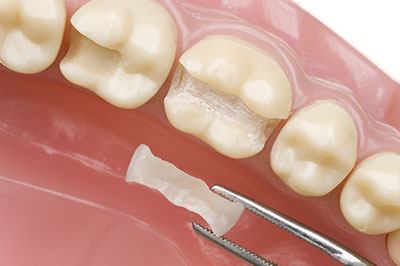
Dental inlays and onlays offer an excellent alternative to “direct” amalgam or composite fillings to restore teeth that have sustained some damage, but not enough to require a full coverage crown. While “direct” fillings such as dental amalgam and composite fillings are placed immediately after the decay or damage is removed and the tooth is prepared, inlays and onlays are known as “indirect” fillings. This means that they are fabricated outside of the mouth prior to final bonding or cementation.
While in the past, many inlays and onlays were caste from gold; today’s dental inlays and onlays are typically custom made of either the highest grade of dental porcelain or composite resins. In addition to providing an exact match to the color of tooth for a cosmetically pleasing result, inlays and onlays have the distinct advantages of being more durable than other fillings, preserving more underlying tooth structure and actually strengthening the tooth so that it can bear up to 50 to 75 percent more chewing forces.
Inlays and onlays only differ from each other in the amount of tooth structure they cover. An inlay is fabricated when the replacement of tooth structure does not require coverage of any cusp tips. If the damage from decay or injury is more extensive and involves more of the tooth’s chewing surface, including one or more cusp tips, an onlay is required.
Both inlays and onlays are fabricated outside of the mouth based upon the exact specifications provided by an impression of the prepared tooth. The final inlay or onlay is then custom made by either a dental laboratory or in-office with a same day system.
Inlays and onlays are custom-made restorations fabricated to fit a prepared area of a tooth that has been damaged by decay or trauma. An inlay restores the central chewing surface between the cusps of a back tooth, while an onlay covers one or more cusps and can extend over a larger portion of the biting surface. Both restorations are typically made outside the mouth and then bonded to the tooth to provide a precise fit and strong seal.
Porcelain inlays and onlays offer a natural appearance, excellent stain resistance and the ability to strengthen weakened tooth structure. When bonded with modern resin cements, porcelain restorations can improve the tooth's resistance to fracture, in some cases increasing strength by as much as 75 percent. Because they are conservatively designed, inlays and onlays preserve more healthy tooth structure than full crowns while delivering long-lasting esthetic and functional results.
Inlays and onlays occupy a middle ground between direct fillings and full crowns in terms of size and coverage. Direct fillings are placed and shaped inside the mouth and are ideal for small to moderate cavities, while crowns encase the entire visible portion of the tooth and are used when extensive structure is lost. Inlays and onlays are lab-fabricated for a precise fit and are chosen when a restoration is larger than a filling but the remaining tooth is sufficient to avoid full-crown coverage.
Onlays in particular can rebuild and protect cusps that are cracked or weakened, which in many cases preserves more natural tooth than a crown would require. Because they conserve tooth structure, inlays and onlays often result in a stronger, longer-lasting restoration compared with large direct fillings. A clinician will evaluate the amount of remaining tooth, the location of the damage and the patient’s bite to determine the most appropriate option.
Common materials for inlays and onlays include porcelain or ceramic, composite resin and gold alloys. Porcelain and ceramic are prized for their esthetics and color match to natural teeth, while composite resin can be used for more conservative or same-day applications. Gold remains an excellent option when maximum strength and longevity are priorities, though it is less commonly chosen for visible teeth due to its metallic appearance.
The choice of material depends on the location of the tooth, functional demands, esthetic goals and the clinician’s recommendation. Porcelain and ceramic restorations pair well with adhesive bonding systems that create a durable interface with tooth structure. Material selection balances durability, wear characteristics, biocompatibility and how well the chosen option matches the patient’s natural dentition.
Patients who have moderate tooth decay, a fractured cusp, a large existing filling that needs replacement or a tooth that is weakened but still has substantial healthy structure are often candidates for inlays or onlays. These restorations are particularly useful when a direct filling would not provide sufficient strength or when a crown would remove more healthy tooth than necessary. A clinical exam and appropriate imaging help determine whether an inlay or onlay is the conservative and durable choice for a particular tooth.
Certain factors such as heavy bite forces, severe bruxism, extensive root canal treatment or significant loss of vertical tooth structure may steer the treatment toward a crown instead of an inlay or onlay. The presence of gum or periodontal issues, as well as the location of margins relative to the gum line, also influence candidacy. Your dentist will review your oral health, functional needs and esthetic preferences before recommending the optimal restoration.
The procedure typically begins with a thorough examination, local anesthesia as needed and careful removal of decay or old restorative material. The dentist then shapes the remaining tooth to create an ideal impression surface and records the prepared area using a conventional impression or a digital scan. A temporary restoration may be placed while a dental laboratory fabricates the custom inlay or onlay.
Once the final restoration is ready, the dentist verifies fit and occlusion, then bonds the piece to the tooth using a strong adhesive resin. The bonded restoration is polished and any final bite adjustments are made to ensure comfortable function. The entire process emphasizes precision to create a seamless margin and a durable connection between the restoration and tooth.
Caring for an inlay or onlay is similar to caring for natural teeth and includes twice-daily brushing with fluoride toothpaste and daily flossing to keep the margins free of plaque. Patients should avoid chewing very hard objects like ice or hard candies directly on the restored tooth and be mindful of habits such as nail-biting or pen chewing that can stress restorations. If you experience new or persistent sensitivity, biting discomfort or a change in how the bite feels, contact your dentist for an evaluation.
Regular dental checkups and professional cleanings allow the clinician to monitor the restoration and the health of surrounding tooth structure and gums. Protective measures such as a night guard may be recommended for patients who grind or clench their teeth to reduce the risk of fracture. With appropriate hygiene and routine care, inlays and onlays can provide long-term function and esthetics.
Longevity varies by material, oral hygiene, bite forces and the quality of the original preparation, but many inlays and onlays last a decade or more when well cared for. Porcelain and gold restorations are known for their durability and wear resistance, while composite onlays may have a shorter lifespan depending on functional demands. Regular dental evaluations help identify early signs of wear, marginal breakdown or recurrent decay that can affect longevity.
Factors that shorten lifespan include poor oral hygiene, uncontrolled bruxism, high-sugar diets that increase caries risk and traumatic forces on the restoration. When problems are detected early, repairs or refinements can extend service life; in other cases a replacement restoration or alternative treatment may be necessary. Your dentist will discuss realistic expectations for lifespan based on your individual situation and the chosen material.
As with any dental restoration, risks include postoperative sensitivity, marginal staining, debonding, fracture of the restoration and recurrent decay at the restoration-tooth interface. In some cases, a tooth may later require additional treatment such as a full-coverage crown or root canal therapy if structural issues progress or if the restoration fails. Meticulous preparation, precise bonding protocols and proper material selection reduce the likelihood of many common complications.
Patients with heavy occlusal forces or parafunctional habits are at greater risk for fracture or wear of the restoration, so addressing those conditions is an important part of treatment planning. Regular follow-up visits allow the dentist to monitor integrity, correct minor issues and intervene before more extensive problems develop. Open communication about any changes in comfort or function helps catch complications early and maintain long-term success.
An onlay can prevent the need for a full-coverage crown when it replaces and supports missing cusps while preserving the remaining healthy tooth structure. By covering and reinforcing critical areas of the biting surface, an onlay restores function and distributes chewing forces without the additional tooth reduction that a crown requires. This conservative approach is often preferred when sufficient sound tooth remains and the structural integrity can be reliably restored with an onlay.
However, when a tooth has extensive structural loss, a vertical fracture, severe decay extending below the gum line or when a root canal has left the tooth brittle, a crown may be the more appropriate choice. The final decision depends on the amount of remaining tooth, prognosis for long-term survival and the clinician’s assessment of functional demands. A careful evaluation will determine whether an onlay is a suitable, durable alternative to a crown in each individual case.
Recommendation begins with a comprehensive clinical exam and diagnostic imaging to assess the extent of decay, fracture lines and the quality of remaining tooth structure. The dentist evaluates occlusion, chewing forces, adjacent restorations and esthetic requirements, and may use digital scanning to plan the restoration precisely. These diagnostic steps help determine whether a conservative inlay or a larger onlay is the best option to restore form and function.
Treatment planning is individualized and includes a discussion of material choices, expected outcomes and follow-up care to maintain the restoration. At Rise & Shine Dental Group, we prioritize preserving healthy tooth structure while delivering reliable, natural-looking results through careful planning and modern adhesive techniques. Patients receive a clear explanation of the recommended approach and what to expect during and after treatment.